This letter was written by Francis (“Frank”) Marion Phelps (1844-1919) who was a student at Lawrence University in Appleton, Wisconsin, in the late 1850s. Frank was married in Manhattan, New York, on 11 June 1867 to Alice Maria Mack (1846-1919). After their marriage, the couple lived in DePere, Brown county, Wisconsin, where Frank made a living manufacturing hubs and spokes. By 1880, the couple had moved to Oakland, California, with their three children to work in the lumber business. By 1900, Frank was working as a mining engineer.
Frank enlisted on 12 September 1861 in Co. C, 10th Wisconsin. He was discharged from the regiment on 18 March 1864 and transferred to the 38th Wisconsin Infantry where he became a 2nd Lieutenant in Co. E. He rose to the rank of 1st Lieutenant before being discharged from the service on 26 July 1865.
Frank wrote the letter to Jackson Tibbits (1813-Aft1880) of Appleton, Outagamie county, Wisconsin. Jackson was born and raised in Boonville, New York, but came to Wisconsin Territory in 1842, settling first at Milwaukee and then moving to Appleton in 1851. He worked for a time in the lumber industry and then grew active in the First Congregational Church in Appleton as a deacon and home missionary. Frank may have worked for Tibbits in the lumber industry for a brief period of time prior to the Civil War.
This letter contains an incredible first-hand account of the Battle of Chickamauga.
[Note: This letter is from the personal collection of Jim Doncaster and is published by express consent.]
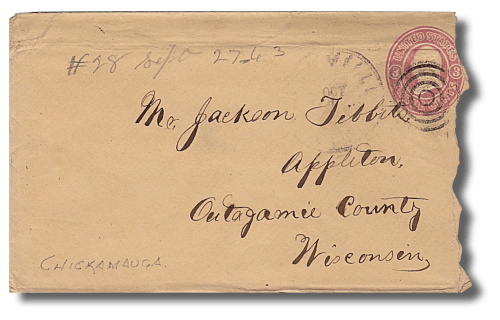
TRANSCRIPTION
Chattanooga [Tennessee]
September 27th 1863
Dear Friends,
What changes has there been since I last wrote to you & what scenes has not this army been through. It seems almost impossible for me to write as I look back & see what our division was then & where it is now. But I will commence where I left off in my last. We were then camped at the foot of Lookout Mountain.
The next morning we started to cross over. It took us until noon to get our train on top. At ½ 12 we started & such climbing. I hope we will never have to cross over another mountain if it is like this one. It is steeper than any roof in town. It is so for miles. When we got on top, we rested for an hour when we started on & commenced to go down. It took us from dark until 10 P. M. to get down. I thought we would never find the bottom.
When we got down we were ordered not to take our accouterments off as there was a large force of Rebels not a great ways off. We had to get up at 3 A. M. & stand by our arms waiting for them but they did not come so at daylight we started on to where General Negley was camped. We got out there & found that he had fallen back a mile to the cross roads—that is, at the four corners of the roads; one road going cross the valley & the other going down the valley from Chattanooga to Rome—the road that the Rebs was retreating on. Well, that day we lay in line of battle most of the time when the Rebels—getting large reinforcements—commenced to flank us, and we had to fall back. There was only two small divisions of us & two corps of the Rebels. About dark the Rebels pitched into us but did not make much. That night we were not allowed to take off our knapsacks so we did not get much rest.
The next day the other two divisions of our corps came up & at night we went out but could not find any Rebels so we came back to our old camp.
On the 17th we started up the valley for Chattanooga or to open communications with General Crittenden’s corps. We marched most of the forenoon when we came up with Crittenden. We passed by his headquarters & bivouacked in a field about 100 rods from the Rebel pickets. Here we stayed all day & night. The next day (18th) was very windy and cold. Our regiment was ordered on picket. We got all ready when orders came for us to march. The Rebels were massing their troops on our left. Our regiment was to act as flankers, ½ of the regiment to be deployed on each side of the road as skirmishers.
We started about 5 P. M. & went out to the picket line and deployed. We marched about 3 miles & halted & came back to the road. At dark we went again but lost our way & run right into a secesh camp. We got out of that & came back to the main column. Then the left of the regiment started but they did not go a great ways when we got into General Palmer’s camp. Then the flankers were called in. About midnight we stopped for a little rest. I laid down & slept about an hour. When we started on Saturday, the 19th, we halted where a crossroad joined onto the main one. Our division formed in line of battle on the left hand side of the road, face the other way. We knew we would have to fight for the whole army was here & we passed General Rosecrans’ headquarters during the night.
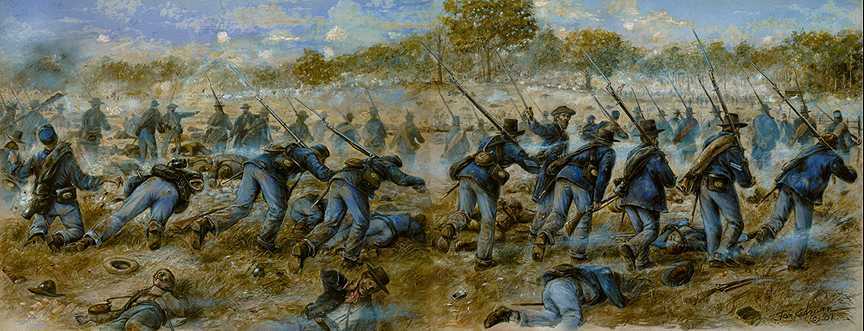
About 9 o’clock our brigade was ordered forward. We advanced about a mile into the woods when we came up with the rebels. We charged on them, capturing a good many prisoners & driving them back. After we had driven them about a mile, they left, yet was still around our line. We could hear them fighting on our left. Pretty soon General [Absalom] Baird (he had command of our division in the absence of General Rousseau) came up & said that the rebels were advancing on our right so he had our regiment deploy on the [side] of the 38th Indiana. Co. A of our regiment was sent out as skirmishers. Pretty soon we could see them advancing. Our skirmishers fell back on the regiment. We laid down to wait for them. Now we were put in a very poor position. Our regiment was on the extreme right of our brigade. The 2nd brigade should have formed on our left but they did not get up in time. We lay on a side hill with our heads a foot lower than our feet with our knapsacks on. ¹ Loomis’ battery [1st Michigan Artillery, Battery A] was planted right behind us so we could not get up. When the Rebels came up, we got up & poured a volley into them, but what surprised us was instead of those in front firing back, we received a murderous fire right on our flank & rear. Then those in front charged on us and we were compelled to fall back, leaving the battery except one gun. ² In the fire our company lost 3 killed & 4 wounded. My mess mates George Wright & John H. Jewett ³ were killed. H[enry] M. Goodwin— brother to Sawyer Goodwin of Menasha—was killed. The Orderly [Martin L. Jenkins], another of my mess mates, was wounded. How I got away without a hit is a wonder.
We fell back about a ½ mile when the brigade was formed again & we went back to the road & rested there a while when we started for the front again. About dark we were out as far as we was in the morning. I went out to where our line was and got what things I could from our boys but everything had been taken. I got John Jewett’s diary. The bullet just hit one corner of it. It is all covered with blood. I did not get anything except a testament from George. These things I will send to their folks as soon as I get a chance.
Saturday night we fell back to the road & stayed. Early in the morning we started back to where we was in the afternoon. Here we formed a line & commenced to build a breastwork out of logs & rails as we knew that we would have to fight hard here. But it seems it was decided that I should not fight there for I was detailed by the colonel to go back after some water for our company. There was another man to take my gun that had none. So I started back for the rear 2½ miles to water. I got back and got my canteens filled to go back when the rebels made a charge and turned our left. I had just started back when they commenced to shell the Hospital where I got the water so I was cut off from the division & no chance to get back, but a very good chance to be taken prisoner as there was no troops between us & the rebels. So the surgeon-in-charge told us to go back to where he was going to establish another hospital, but I did not go back.
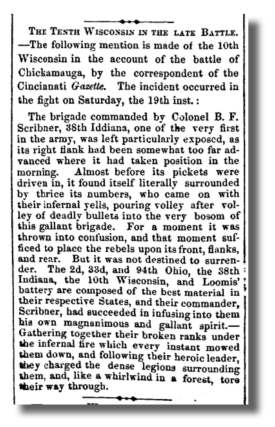
Another boy of our company & I got on top of a high hill just back from the battle field & stood there watching the rebs. But at dark, after trying to get through several times, we went back to the cove. When we got back there we found the whole army there. Found out that we had been whipped [and] that our whole division was cut up, our brigade gone, and none of our regiment [remaining] except 22 who can tell of our loss. Our regiment went into the fight [with] 261 men and 20 officers, came out with 22 men and 4 officers. Loss: 239 men, 16 officers killed, wounded or missing. Our colonel is killed, Major [Duncan McKercher] wounded & [taken] prisoner. The rest the same. We cannot learn anything about them. Our officers said that the men fought well. How I have wished that I was with them. Oh, you don’t know how lonesome it is with only a little squad left of once a full regiment, but now they are all gone.
On Tuesday we came back to this place here. We have been fortifying. All sick have come up so we have 50 men in the regiment now. Cousin Jim was over here just now. He is not very well—worn out with exposure. They are going to try and get us back where we can guard. There is one company that has not been in the fight yet. That will make about 80 men in all. Our brigade has about 1000 men in all 5 regiments. We are now where the rebels cannot flank us very easily. I guess the fighting is over. I hope so at least for a while. But I must close. Write soon as you can. Love to all at home. Never mind about those things I sent for. Don’t send them yet. I don’t know as I shall need them.
Write and let me know when you get this. — Frank Phelps
¹ In his book, The Chickamauga Campaign: A Mad Irregular Battle…”, author David Powell wrote that “The 10th Wisconsin began this stage of the fight [in Winfrey Field] in reserve, slightly behind and to the right of Van Pelt’s battery [Loomis’ Battery]. When the guns turned to fire into the charging Confederates, the Badgers found themselves prone in front of the firing guns, head forward on a downward slope. To stand rushed being blown apart, and remaining prone meant they couldn’t easily reload of they could reload at all. Before the Wolverines could engage the enemy, however, someone yelled for the men to get to their feet and open fire, recalled Lt. Lucius Hinkley of Company K, “but Van Pelt’s gunners, with lanyards ready to pull, shouted: ‘Lie down!’ ‘Lie down!’ which for a moment kept our boys flat, while the canister from the guns hissed over them…Situated in such an awkward and dangerous position, the 10th broke. “Somehow,” marveled Lieutenant Hinkley, the men “got from under the muzzles of the cannon and to the rear.” [Page 330-331]
² Loomis’ Battery A was commanded by Lt. George W. Van Pelt and attached to Scribner’s Brigade, Baird’s Division, Thomas’ Corps. The battery advanced from Birds Mill on the evening of the 18th and arrived at the intersection of the Lafayette and Chattanooga roads at daylight of the 19th and from there to the location of the present day monument on the field marking the location where they were deployed as described in Frank’s letter. After firing 64 rounds of canister and shell at this location, the enemy rushed the battery in overwhelming numbers, compelling the supporting infantry—of which the 10th Wisconsin were a part—to fall back. The battery remained at the position firing away until five of the guns were captured. Only one gun was able to leave the field. Lt. Van Pelt and five of his men were killed, 6 were seriously wounded, and 13 taken prisoner. The location of the monument is on the north side of Brotherton Road near Winfrey Field.
³ John H. Jewett (1839-1863) was married at Ingham, Michigan to Mary Mandervill on 11 January 1860. He enlisted on 1 November 1861 as a corporal in Co. C, 10th Wisconsin.


 Spared & Shared 21