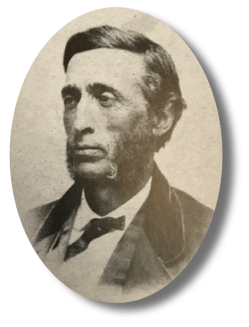
This letter was written by 19 year-old Alfred MacKenzie Brown (1811-1903), the son of William and Hanna Street Brown who came to Larue county, Kentucky, from Hanover, Virginia. In 1844 in Bardstown, Kentucky, Alfred married Mary Bell Stone.
Alfred wrote this letter to his older brother, John Thompson Street Brown of Munfordville, Hart county, Kentucky. There is a historical marker in the town of Munfordville that provides the following family information: This village’s first postmaster and a charter member of Munfordville Presbyterian Church, John Thompson Street Brown (1793-1875) is the forbear of a remarkable and internationally known Kentucky family. William and Hannah Street Brown settled 1,000 acres on Nolin River north of here in 1792. Their son, J. T. S. Brown, bought 435 acres, later called “Summer Lea,” three miles west of here. After his marriage to Elizabeth Creel, daughter of Elijah and Ermine Creel, whose house off Old Street overlooks the river, he and his wife built the brick home north of the Creel house. Their third child, J. T. S. Brown, Jr., born here in 1829, married Emily Graham in 1856. After moving to Louisville, they returned many summers to the family retreat at “Summer Lea.”
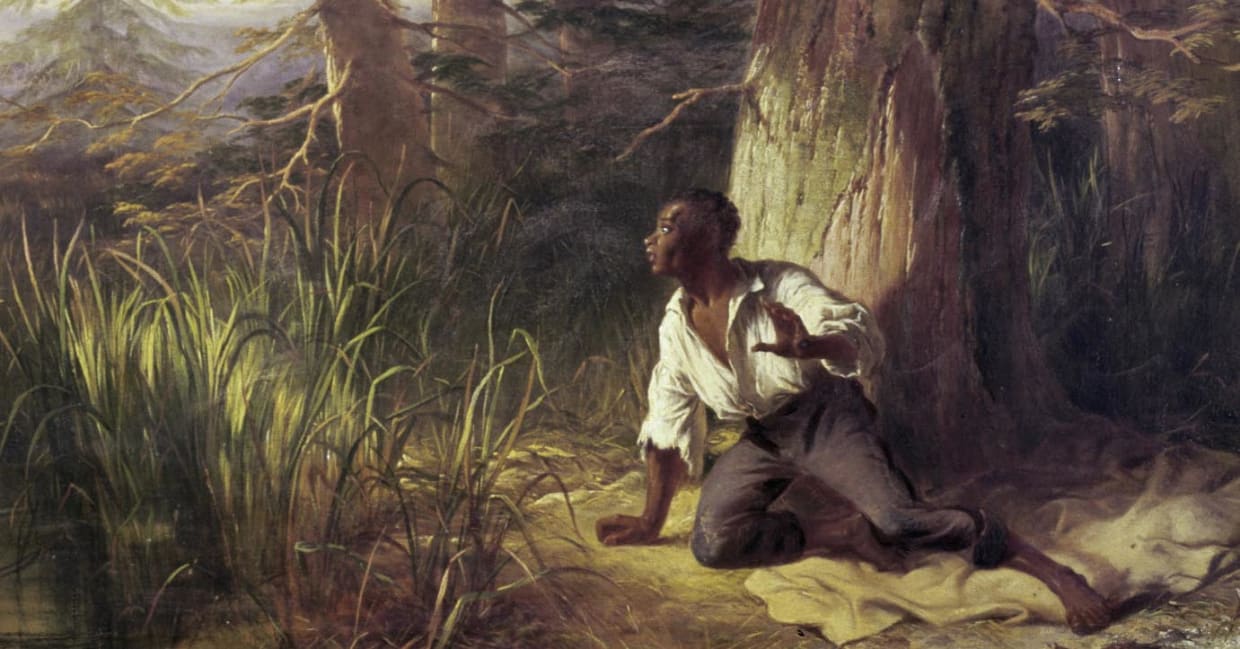
[Note: The painting in the header is entitled, “The Fugitive Slave,” painted by John Adam Houston]
TRANSCRIPTION
Addressed to Mr. J. T. S. Brown, Post Master, Munfordville, Ky.
Elizabeth Town, [Hardin county, Kentucky]
29th August 1830
Dear Brother,
On Friday evening last the Presbyterian Meeting commenced here. On Saturday night I heard Mr. Scot (a presbyterian) preach. The subject of his sermon was the faith of St. Paul. I was much pleased with the manner in which he treated it. He reasoned strongly and his sermon was quite interesting. If you have never heard him, I think you would be pleased with him as a preacher though you would differ a little in some doctrinal points. He preached (as most of the Old Presbyterians do) John Calvin, though indirectly.
I received a letter this morning from Bro. George [Park Brown (1810-1839)] that informed that you and family were well. Also about the outbreaking and stealing of the Negroes near Munfordville. I was sorry to hear that Jesse had taken such wild notions as to think about running away. ¹
The sickness about here is abating. All who were sick is getting well, I believe, except those who died. ²
I saw [my son] William [B. Brown, (1824-1895)] on Monday last. Friends on Nolin [River] were well. I would be glad to come over to Munfordville shortly but at this time it is out of my power. I will come over to see you as soon as an opportunity offers. I am engaged closely at business but feel in entire good health.
Respectfully, — A. M. Brown
[to] Mr. J. T. S. Brown
In our account of sale of tobacco two hogshead were marked with some numbers and we do not know how to distinguish them. One is F Inpe No. and one No. 78….
¹ The proximity of Kentucky to the frees states made “slave stealing” a bigger issue as the Underground Railroad made it relatively easier to assist slaves to freedom. In 1830, Kentucky legislators toughened the state laws pertaining to slave stealing.
² This is no doubt a reference to the Asiatic Cholera which prevailed in the United States about 1830—particularly in Kentucky—during the summer months.


 Spared & Shared 21