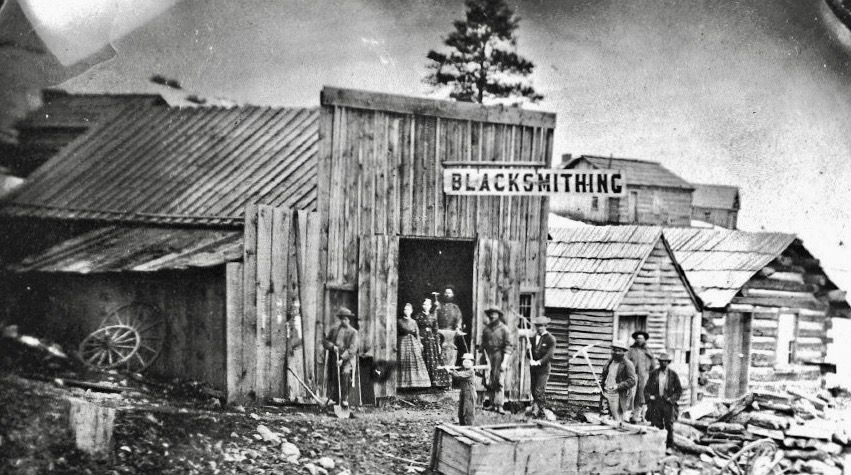
This partial letter was written by a unidentified gold miner or supplier to the gold fields in Baker county, Oregon, in 1862. In his letter, the author mentions several prominent early settlers of the region. The image in the header was taken in Auburn in the 1860s. There is an outside chance this letter was written by David Smalley Berryhill (1827-1907), the son of Alexander Berryhill of Ohio. He arrived in California in the spring of 1852 and after many years gold mining in CA, OR & MT he bought a large ranch in Hereford, Burnt River area of Baker OR and settled down. David was an adventurer and bachelor. He took a [Tom Sawyer like] trip on the Missouri River to visit his sister and other family in Iowa before hopping a stagecoach back out west. He was known to have gone to Auburn, Baker county, California, in the spring of 1862. He had a sister named Julia Anne whom he might have called “Annie.”
The following comes from a local history: “While the gold fields in the southwestern part of Oregon were discovered about 1852, those of the Blue Mountains remained unknown until about ten years later. Early in the spring of 1862 D. Littlefield and a party of four or five men discovered the rich placers of Auburn. In a very short time miners came pouring in from all directions, and the town of Auburn, laid out in June, 1862, grew rapidly, until in less than a year it contained 5,000 inhabitants. In those days the Blue Mountains were difficult of access, supplies having to be brought in from The Dalles, a distance of 300 miles. Auburn was the first settlement of any size in eastern Oregon and was the first county seat of the newly formed Baker County. The placers at Auburn were exhausted quickly however, and by 1873 the population of Auburn had dwindled to about 200 people. The Auburn post office closed in 1903, and today nothing remains of the town.”
TRANSCRIPTION
Auburn, Baker county, Oregon
Sunday, December 7th 1862
My dear Sister Annie,
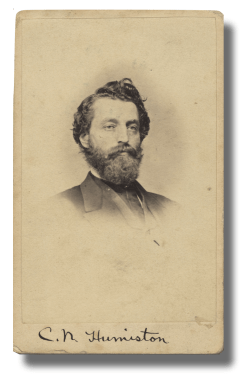
Thursday 24th sick. Friday 25th at 12 midnight arrived at San Francisco. Here I remained in charge of Doct. H. M. Gray ² —a first rate physician and a gentleman—taking sea baths, fresh water showers baths, exercising in the gymnasium, riding etc. until Sept. 5th when acting under the doctor’s advise—which was to make a sea voyage—I took passage on the Barque “Helen Waling.”
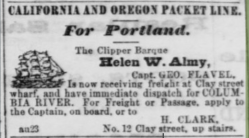 Extract from my memorandum book, “Left San Francisco on “[Clipper] Barque [Helen W.] Almy” on Friday, September 5th 1862 at 9 a. m. for Portland, Oregon, Capt. George Flavel in command, 6111 tons freight on board, deeply laden. Was towed out by the little tug Monitor—a fine stout little steamer. My friend and companion du voyage Mr. Charles Lemon and myself regret very much leaving the pleasant society of San Francisco. Hope we may be successful in accumulating sufficient means in a few years to return to our friends in the East.
Sunday 14th. Nothing of interest has occurred thus far. Have been quite sea sick. Feel rather better today. Light variable winds—wind from every quarter except the right one. The Capt. (very sociable, kind & gentlemanly) is somewhat vexed today and anticipates a long passage. My friend Mr. Lemon is well and in apparent good spirits. The first day out we ran into a school of humpback whale. Could hear them blowing and puffing all about us. Since them we have seen nothing. Saw a few “Boobies” and one school of porpoise. Today a small white “Gull” I observed flying about. Yesterday saw one solitary little “petrel.” Passed the day very quietly. Have tacked ship twice. At this, 4 p.m., barometer is falling indicating a change. Hope it is for the better.
Monday 15th. Nothing of interest has transpired today. Saw a large whale about noon and a flock of Mother Carey’s Chickens. Tuesday 16th—went on deck this morning, found the yards braced square around and a fair breeze—first fair wind we have yet had. There is now a prospect of reaching Columbia river bar by Thursday. Wind from the Southwest.
Thursday 18th. Latitude today noon 43° 12′ Longitude 1311° 56′. This evening a snipe alighted on the top rail. I came very near capturing him. Rather singular occurrence. Friday 19th. Beautiful morning. Since Tuesday have had a succession of calms, varied with puffs of wind. Day before yesterday Lemon and myself very nearly caught a shark—a blue nose. Got him almost aboard when the hook came out and we lost him. The Captain says this has been a remarkable calm trip—all hands busy painting ship this evening. Got a fair wind. Braced the yards square and bowled off handsomely before it. Captain and all hands in good humor. We are now making 6 knots per hour.
Saturday 20th. Blowing quite a gale. Seasick all day. Heavy sea running. Passed Tillamook Point at 2½ P. M. Gale subsided at 4 P. M. leaving a tremendous sea on. Made 10½ knots per hour for the past 12 hours. Sunday 21st, Pilot came on board at 6 P. M.—too dark to go in over the bar. Crossed the bar at 12 M and came to anchor just inside the buoy where we lie waiting for wind (Pelican) Astoria in the distance. Upriver clean & beautiful. Seaward Cape. Disappointment looms up frowningly. The sun just setting tinging the water beautifully—added to which the dark green of the wooded hills & shores made a most charming scene.
Thursday. October 9th 1862 at 1 pm we reached the foot of the Blue Mountains, overtook several teams. Camped on the summit of Blue Mountains this night at a place known as “Lee’s encampment.” Quite a jump-off, it it not from the Columbia river bar to the Blue Mountains or rather a jump up. I reached Portland…
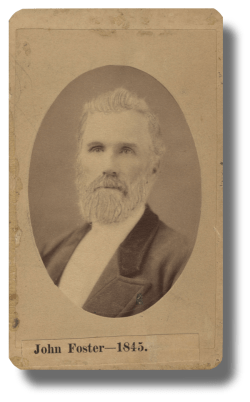
¹ John R. Foster (1826-1906) was born in Saratoga county, New York. Orphaned at the age of 7, he was taken in and educated by an uncle until he reached maturity when he came to California by the Panama route in 1850. He worked for a time as a clerk in San Francisco but then went to Oregon and entered the store of Allen & Lewis where he managed the hardware department. He eventually bought out the business and also entered into a partnership with Robertson at Umatilla, a branch of the Portland store.
² Henry M. Gray (1821-1863) was born in New York City, son of the Reverend William Gray, a Scotch Presbyterian clergyman. Soon after his birth his family moved to Seneca Falls in northeastern New York State where he spent his youth and early manhood. His medical education consisted of an apprenticeship with a private physician in nearby Almyra and graduation in 1842 from Geneva Medical College, a “country medical school” that was moved to Syracuse, New York, and became the Medical Department of Syracuse University in 1872. To commence the practice of medicine he moved back to New York City where his bright mind, pleasing frankness of manner and gratuitous practice among the poor soon won him a secure professional and enviable social position. Although he was assured of speedy eminence as a New York physician, his love of adventure and the excitement of the California gold discovery led him to close his office and organize an immigrant party of ten congenial spirits – college mates, friends and associates. They purchased the bark Hope and set sail in July 1849 on the six-months’ voyage around Cape Horn to the gold fields of California, he acting as the surgeon of the expedition. Touching en route at Rio de Janiero, they reached San Francisco in December. Some of the party, including Dr. Gray, visited the mining regions, but he returned to San Francisco in a few months where he immediately commenced the practice of medicine, to which he thenceforth devoted himself. His practice, at first limited, grew to be among the most extensive in San Francisco, and so lucrative that in a few years he acquired a considerable fortune that enabled him to support not only his expensive habits but to make liberal contributions to the many charities that appealed to him for aid. As in New York, he was generous in his services to needy patients so that his kind offices were legendary in the community. He was a member of the San Francisco Medical Society and San Francisco Pathological Society, associations that were initiated by the pioneer group of physicians.


 Spared & Shared 21