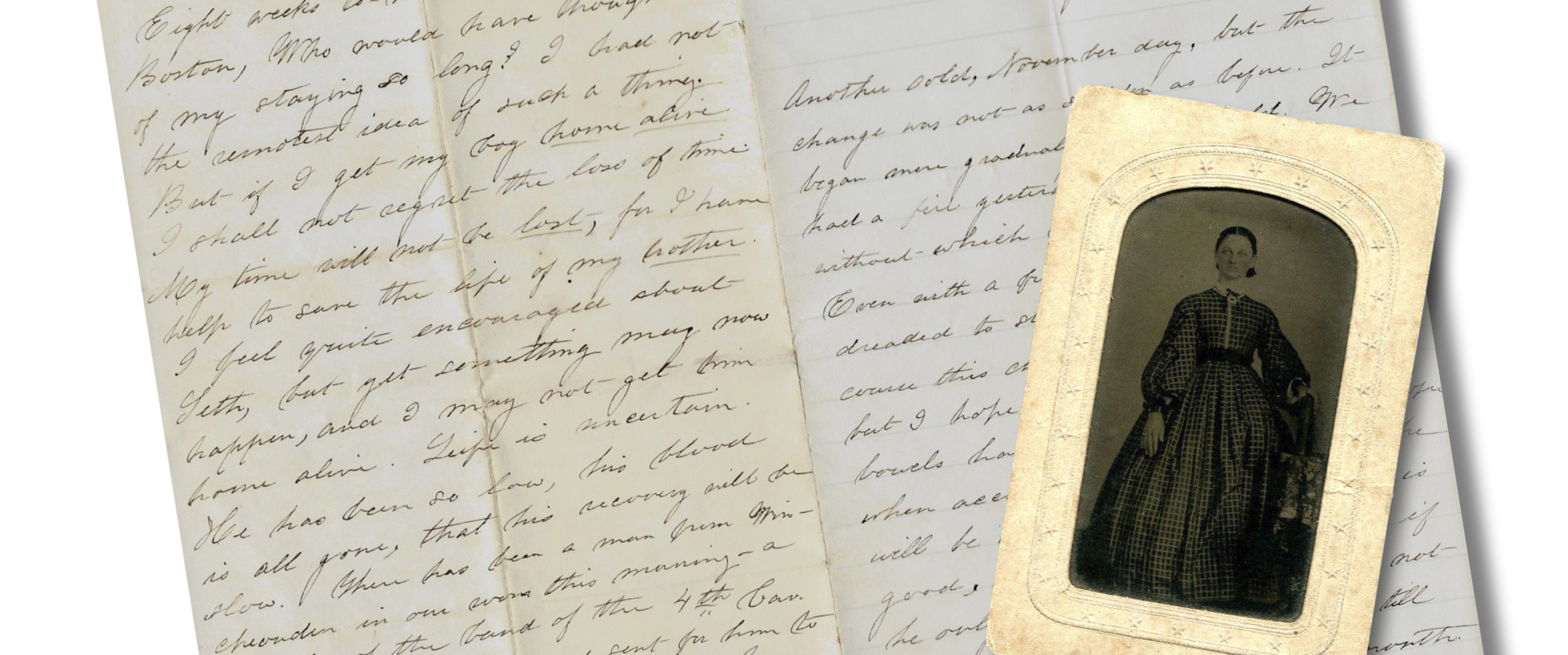
This incredible letter was written by 27 year-old Minerva (“Min”) Florilla Hale (1837-1914), the daughter of Oliver Hale (1804-1853) Sarah Davis Parker (1808-1891) of Hubbardstown, Worcester county, Massachusetts. From the letter we learn that Minerva was attending her sick younger brother, Seth Parker Heywood Hale (1846-1923)—a trooper in Co. F, 4th Massachusetts Cavalry. Seth accepted a bounty in March 1864 to join the regiment. He remained in the service until 7 June 1865 when he was mustered out for disability.
From Seth’s military file we know that he was hospitalized in late July 1864 at the US Army Hospital at Point of Rocks, Virginia. A record in Seth’s military file, however, suggests that he was awarded a thirty day furlough on 18 November 1864 by Asst. Surgeon J. H. Frantz. That paper indicates that Seth was “suffering from chronic diarrhea of several months standing.” At this time, Seth was in the Balfour Hospital at Portsmouth, Virginia, which was no doubt where this letter was penned a couple of weeks earlier.
TRANSCRIPTION
[Balfour Hospital, Portsmouth, Va.]
Sunday morning, [November 6, 1864]
Another cold November day but the change was not as sudden as before. It began more gradually to grow cold. We had a fire yesterday and all night without which we should have suffered. Even with a fire, it was so cold one dreaded to straighten out in bed. Of course this change effected Seth but I hope nothing seriously. His bowels have been looser, but I hope when accustomed to the weather he will be alright. His appetite is good and Dr. seems gratified if he only eats well. We shall not have settled weather they say till past the middle of the month. I asked the doctor the other day again how soon Seth would be able to go North. He again said he could not tell. He must be able to sit up three or four hours in succession, stand alone, and walk some. He is going to try and sit up a little while this afternoon. I hope he will not be any worse for it. He is willing to do more as I desire than he [did] formerly. Doctor, too, is beginning to think I know something. He asks me how Seth is instead of asking Seth himself. Seeing me twice in the lower hall in one day, he inquired how my brother was, and did not come to see him all day. They were very busy—all the doctors—caring for the wounded men brought in last week. They were terribly cut to pieces and the doctors have been cutting them up ever since. They have been here amputating legs and arms, cutting out balls and such like. But they were niggers and I do not care for them as for our white men. The war is for the blacks, and they ought to share in the loss. ¹
It is cold enough for winter clothes. I saw cloaks and velvet bonnets yesterday and today, but I do not want you to send me anything. I can get along. Will buy rather than risk sending my clothes. Had a letter from [sister] Clara yesterday. They had a fire up on E. Newton Street [in Boston]. I read the news in the Barre Gazette. ²
Mr. & Mrs. Walker called on me last Friday but I had gone to supper so I did not see them. They left word that they would call again. I shall be glad to see a familiar face. Seth also has seen Mrs. Walker while at Boston last winter. Hope she will be neighborly.
Eight weeks tomorrow since I left Boston. Who would have thought of my staying so long? I had not the remotest idea of such a thing. But if I get my boy home alive, I shall not regret the loss of time. My time will not be lost, for I have help to save the life of my brother. I feel quite encouraged about Seth but yet something may now happen and I may not get him home alive. Life is uncertain. He has been so low—his blood is all gone—that his recovery will be slow.
There has been a man from Winchendon in our room this morning—a member of the band of the 4th Cavalry. We heard he was here and sent for him to come in and find out where Co. F was. He did not know, having been to Washington for 50 days, and sick some weeks before that time. He is a nice young man, I judge. Said he would come in again. He is acquainted with Uncle Luke.
Write again soon for we enjoy your letter. — Min
¹ The Black soldiers may have been some of the wounded from the Battle of New Market Heights that took place on 29 September 1864.
² The large fire on East Newton Street in Boston was probably the one that burned down Hallett & Davis’s Piano Factory. That fire occurred on 27 September 1864.


 Spared & Shared 21