
These letters were written by John Beylard (1793-1879) to his daughter-in-law, Maria Caroline (Murphy) Beylard (1827-1904). John Beylard was a native of Paris, France, who spent a number of years as a Philadelphia merchant importer. In 1821, he was married in Christ Church in Philadelphia to Elizabeth Henrietta DuBarry (1804-1861). It was John’s son, Henry DuBarry Beylard (1822-1860) who married Maria, the daughter of Andrew Murphey and Mary Seymour Mead. Several years after Henry died, leaving her a widow to raise their son Louis (1854-1904), Maria married Rev. Dr. William Rudder, rector of St. Stephen’s Protestant Episcopal Church of Philadelphia.
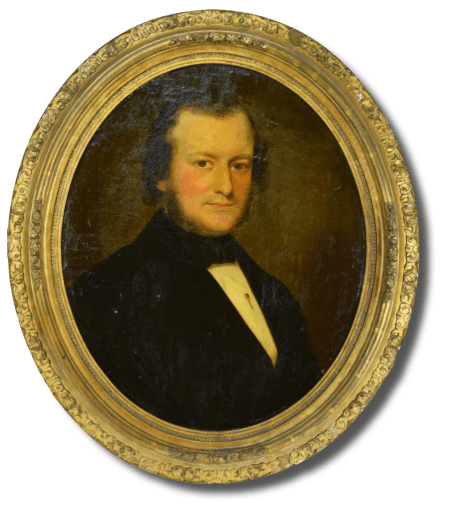
The portrait of Henry Beylard (above) was painted by American artist Thomas Sully about 1850. An old label verso reads ,“Henry DuBarry Beylard son of John Beylard born in Philadelphia August 7, 1822 and died January 17, 1859.”
The letters would be of particular interest to descendants of this family, of course, but are also of general interest to Civil War historians who will gain some insight as to the perceptions of the American Civil War through the eyes of one Parisian with familial and financial ties to the United States.
TRANSCRIPTION LETTER ONE
Paris [France]
3rd October 1861
My dear Maria,
I wrote to you on the 10th of August last through the Post Office and hope my letter reached you in Safety.
This is merely to inform you that Dr. Keating who sails for New York, I believe, by the steamer bearer of this letter, has taken charge of a shawl—a mantelet in black lace, and various pieces of black silk lace for you and is to declare the whole to Mr. Nancrede who will send to you as you may direct. I did not see the Dr. myself but hope that he will so manage as not to pay any duties on those articles which, in case of need, he may represent as having been somewhat in use by your poor mother. I hope they may prove acceptable as coming from here.
Nothing new here, Juliet and Lilly have returned to town with their children and all are well.
I have requested Mr. Nancrede who was very a____ to have a likeness of his old friend, my poor wife, to have a photograph taken from the miniature you are to send me, and which he is too forward. Dr. Keating, I understand, is to return to Europe as soon as he is married. It would be an excellent opportunity to send me the miniature, should it not have left Philadelphia when this reaches you. I wrote to Mr. Nancrede accordingly.
What news about the mill? I fear that the present state of affairs stops all its success—if it began to have any.
Most affectionately your father, — J. Beylard


TRANSCRIPTION LETTER TWO
Paris [France]
October 28, 1861
My dear Maria,
Need I say that I have read with a feeling of increased affection for you your good letter of the 12th inst. It confirmed the opinion I have always entertained and expressed of your highly honorable sentiments and I thank you for the heartfelt pleasure it gave me. At the same time, let me say that you are carried away by those sentiments beyond the line traced out by your duty as a mother—that among the debts contracted by your Henry there may be some light ones the peculiar circumstances of which were known to you at the time they were contracted, engaging in some measure your particular responsibility and that in such a case, you should ascertain the desire of settling for them as far as reasonably practicable in your present situation, I am willing to admit; but my dear daughter, beyond this very particular case you cannot, and you ought not to consider yourself bound in the least to pay your husband’s debts with your daily hard earnings. The creditors themselves never expected it, and everyone acknowledges it. Te money thus gained by you is in fact a trust sacred to your child, should it not become absolutely necessary to your actual wants or his. The situation you now occupy through the kind assistance of your brother-in-law, is of a nature precarious. Your health may not (which God forbid) continue to be as good as it is. Thousands of causes in fact may arise making it incumbent upon you to lay all you can save for the earnings of a labor that may be checked suddenly, and I shall feel anxious until I hear that you have done me and yourself the justice to think well of these remarks, and especially to have acted accordingly.
Had the mill in Philadelphia provided something after liquidating what it owes, I might have approved your resolution to apply its income to pay gradually some of those particular engagements that in your estimation seem to require a preference; because the property of that mill, though in your name, was acquired during his existence, and when he was perhaps already particularly engaged, but it this case, I should not give the approval without being made perfectly acquainted with every circumstance attending it.
Thus my dear Maria, I answer your request sincerely and honestly—duly weighing your conscientious scruples as if they sprung from my own breast, and I trust you will suffer yourself to be guided by my advise.
Since the date of your letter you must have received through the agency of Mr. Nancrede the articles given in charge of your old acquaintance, Dr. Keating, and of which I spoke in my own letter of the 3rd inst.—-a shawl, some black silk laces and a “mantelet.” I hope to hear soon that they have reached you in safety. You should of course understood that their main value consisted in their coming from your poor mother.
I did authorize Mr. Nancrede to have a good photograph taken from the miniature he was to receive from you, and I trust he has not hesitated to send you a copy of it. He is also to send one to Miss Greland who wrote to me for it. I am happy to hear that she has now near her niece and family; the only good perhaps resulting from the awful war raging in the United States.
I have no letters from Juliet—-Denny, but I received one some time ago from her father. I should not wish him to know that I made the least reflection on his previous silence and again beg you to keep between us what I may have said on the subject. After all I did for him and his daughter, what he would have done for me, and in his own way, no doubt, he is grateful for it.
As for Edward Dubarg’s letter to me or mine, I do not understand how they can miscarry when nothing of the kind ever happen to my other correspondents. I shall be so cautious hereafter when I have occasion to write to him, that through my fault at least, it will not happen again. Juliet and Lilly had promised to write to you. Why they have not done so, I cannot say. Both are well and their children too. I shall take care to communicate to her that part of your letter which conveys that. I shall be quite gratified to receive the photographs of Louis. I have yours before me while I write. One of these days I shall have one made of Juliet and myself together, and send it to you. I am pleased to see you send Louis to school. I think he is a good boy and anxious to please his mother as well as proud enough not to remain behind other boys of his age. Tell him from his grandfather and let me hear that he does not complain of the school and minds you in everything as an excellent son ought to do. Kiss him for me when he behaves as you desire.
We continue to be very anxious about the news from America. I see nothing in them that does credit to either party; but the South has evidently accumulated all the wrong on its side besides being absurd beyond conception knowing the United States and their institutions, as I thought I did, I never could have believed that I should live long enough to witness so unstable a state of things. I am feeling the affects of it on my income and several of my dividends remain unpaid, but my personal _____ are not now very heavy and I can take patience.
When you see Miss Becky, tell her I am grateful for her that after all, and judging from my own feelings, I consider myself as an “oblige.” May she long give me the chance of being agreeable to her. My kind regards, I beg of you to your Mother and Mrs. Okely.


TRANSCRIPTION LETTER THREE
Paris [France]
November 6, 1862
My dear Maria,
I read with great satisfaction your good letter of the 17th pf September for it gave me such a good account of your past time during your absence from Pittsburg as to realize all I might have wished for your pleasure and comfort. I am grateful toward the friend who that [ ] you and Louis.
….The state of affairs in America continue to give us great uneasiness. We can see no end to its misery. And should servile war arise from the liberation of the slaves, in what awful state will the whole country be thrown? I therefore share in your apprehension of the future. Is a reconciliation possible after such scenes as have taken place within 18 or 20 months? How guilty the South to have undertaken so unjustifiable a war. History furnishes no adequate equal to it. We sometimes imagine that the South must succumb through exhaustion if not through defeat.
I read with satisfaction your answers to my remarks in regard to the thought of having Louis educated in France….


TRANSCRIPTION LETTER FOUR
Paris [France]
17 September 1863
My dear Maria,
….I continue not to receive one cent upon my investments in the South: Alabama and Tennessee. Will I ever get anything? Heaven only knows for Northern successes progress very slowly—and should they be complete, how long before Southern States can be made to pay one farthing of their debts? On the other hand, exchange on Europe, though better, is still ruinous so that for two years I have not had a single remittance made to me!
Adieu. my dear daughter. Believe in may sincere affection, — J. Beylard


TRANSCRIPTION LETTER FIVE
Paris [France]
4 December 1863
My dear daughter,
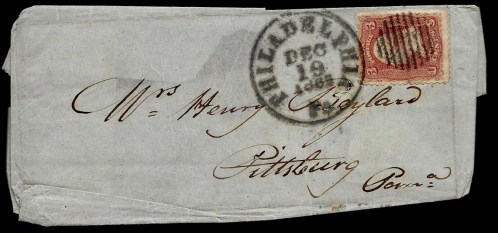
This is in answer to your letter of the 15th ult.—part of which made me anxious was certain circumstances which you say that you cannot explain in a letter seem to render your stay in Pittsburg perfectly intolerable, and induce you to look for another situation. What those circumstances are, I cannot imagine, and, did I not respect your reserve or secret, I would request an explanation for it is a very important step or move that you meditate; and though I am confident you never act lightly, still I persuade myself that my advise founded exclusively on what I consider as favorable to your future welfare, might have some influence on your final determination and, at any rate, induce you to pause before you act.
In the absence of any information which I perhaps cannot ask without appearing inconsiderate, I must confine myself to recommend to you the greatest care in keeping to yourself any intention or plan which might create any ill feeling in the mind of those whom you depend upon, in the least measure for your success or well-being hereafter. That there are unbearable circumstances in life, which therefore require a change, if at all practicable, I am of course disposed to admit; but, my dear Maria, they must really be such, and a woman of your character is not to yield easily before what would frighten or control a weak mind. Our worth, our moral position, is in ourselves, not in the opinion or conduct of others—and, as to the meo_____ of a certain contact, you cannot but own that if you will it, you are perfectly able o please yourself above it, and command feelings unworthy of your own dignity.
Need I say that I, and I alone, would be made acquainted with the motive of your troubles, should you think proper to explain it in your next letter? I trust you do me the justice to believe that no idle curiosity, but your interest alone prompts me thus to attempt to trespass upon your reserve. Let it not however occupy your mind an instant should you continue to feel the least reluctance in speaking freely on the subject. I shall respect your discretion.
I am delighted with your good reports about Louis. It would certainly be a great pity to hear that he has but little pride and ambition in his studies, and lacks behind the others. He has too much heart and soul, I trust, for me to admit of it, and he loves hs good mother too much not to give her every possible [ ]. I am pleased to know that the accident about his finger had no worse consequences. It will teach him, however, to be more cautious. Speaking of caution, his Uncle Edward to whom I read what you say about the gun he sent him, remarked that though he bought the gun for good, it might not be so, and that you should ascertain whether there is the least risk of its bursting. Those sorts of play things are very dangerous for young boys, and I advise you to lay the said gun aside for some years. Recollect what happened to Mr. Nancrede’s son for handling a pistol. It was a great luck for him not to have been crippled for life. I heard at Ridgeway’s the other day that Helen Willing had not returned from Germany nor would be here for some weeks. When I saw her before she left for Italy, she did not look to me as being in better spirits or higher spirits, than usual when in America, and I doubt ,much whether any journey in any part of the world can make the least change in that disposition. One would suppose she lives to live, and nothing more, and God knows it is little enough.
I have just heard from Miss Greland and her niece, Mrs. Eustis, informing me of the marriage and next visit of Laurotte and her husband. She ought to have required a change of such name as Poth, shouldn’t she? the thing is so easy in America! But whatever name she bears, I shall be glad to see the great granddaughter of my good old friend Mrs. Greland, and greet her accordingly.
We have had here Harrison Ritchie ¹ and his wife, both very amiable visitors, and we have received them “on famille” with great pleasure. Harrison is now in England attending to his mission but his wife is still among us. They intend to go back to the U. S. in a month or so.
I am much annoyed as you may suppose with the insignificant news from America—and I see no proposals of a termination of the war before another year. The state of exchange is such that I can receive no funds from America without 40 percent loss, and to this I must add a great reduction on my income, so that you may imagine how deeply my pecuniary interest is affected by this abominable strife. I am aware that prices of all things are very high in America, but I understand that the North and West of the Union are in a very flourishing condition, and I hope some good for you may eventually come out of it.
Speaking of this, is there no chance at all for you ever to recover anything from the Law? Has your brother never looked into it carefully? Does he not reside any longer in Philadelphia? Is your brother-in-law or Mr. Murray acquainted with the President or any influential Director in the Cleveland and Pittsburg Railroad Company? As one of the creditors, I have to complain of the said company. In February last, when Mr, Nancrede received the interest due to me then, in their coupons they did not give him notice that the principal of said coupons was at his disposal and that the interest would cease to be paid from that time. They simply advertised the measure in one or two New York papers and this never came to the knowledge of Mr. Nancrede so that when he called upon them for the interest due from February to August last, they refused to pay it, saying that the capital had been subject to his orders ever since. This looks too much like a trick to favor the company at the expense of the loan holder, for nothing was more simple and natural than to give notice to each creditor when he called for his interest in February last that the capital was ready to be paid. Distant creditors could otherwise not know of the step taken by the company and I can hardly admit that Directors who respect themselves will continue to refuse to pay interest so justly due. I have addressed a letter to the Board through Mr. Nancrede cleaning the amount of my coupons, say 175 dollars, and if your friends are in a situation to exercise some influence in obtaining redress for me I shall feel quite obliged.
Edward, Juliet, and Lettie send you the most affectionate messages, many kisses for you and the good boy Louis. All his cousins are well now. Sophie, now 2½ years old, knows all her letters when presented to her promiscuously. She is more advanced in that than her brother. The little Marie will probably be prettier but a more cunning or intelligent look she never can have. Farewell my dear Maria, — J. Beylard
¹ Lt. Col. Harrison Ritchie (1825-1894) of Boston served in the 10th Massachusetts Regiment and was sent on a mission for the United States to buy ordnance in England. Ritchie died in Paris in 1894. He was married in 1849 to Mary Sheldon.


 Spared & Shared 21