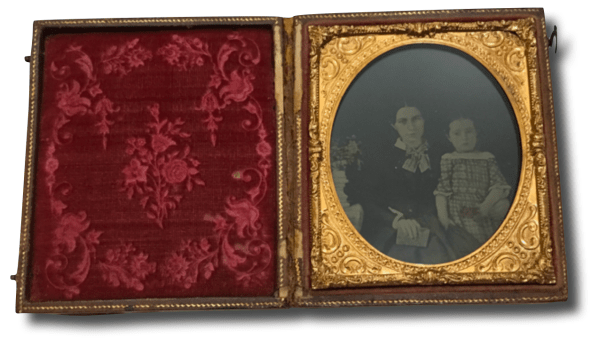
This letter was written by Sarah (“Sallie”) E. (Watson) Alston (1837-Af1900). In the 1850 US Census, Sallie was enumerated in the household of Willie G. Clary (b. 1798) in Windsor, Bertie county, North Carolina. Willie Clary and his wife Eliza had three older children of their own and four Watson Children: John Watson (age 17), Mary A. Watson (age 15), Sarah E. Watson (age 13), and Francis E. Watson (age 11).
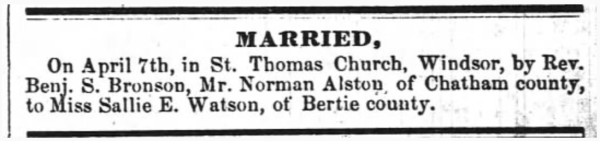
Sallie married Norman M. Alston (1836-18xx) in Windsor, N. C. on 7 April 1858. Norman was the son of Philip Alston and Anna M. Alston of Upper Regiment, Chatham county, N. C. In 1860, Norman and Sallie were residing on a farm in Pittsboro, Chatham county; their daughter Pattie Kerney Alston (1862-1943) was born in 1862. Norman volunteered as a private on 4 June 1861 in Co. M. 15th North Carolina Infantry. His company, and Co. L, were transferred subsequently to Co. I, 32nd North Carolina Infantry, and he was discharged in August 1862 by obtaining a substitute. His military records indicate sickness and though he was discharged from the service, he must have died sometime between 1862 and 1868 when this letter was written.
Sallie wrote the letter to her deceased husband’s step-brother, George Washington Wortham (1823-1883), the son of Dr. James Lewis Wortham (1797-1866) and Rowena Washington (1807-1841). After the Dr.’s first wife died in 1841, he married Charity Dawson Alston (1797-1858) who became George’s step-mother. In 1860, George listed ten slaves on his Tar River District farm in Granville county. During the Civil War, George entered the Confederate service as Captain of Co. D, 12th North Carolina. In 1862, he was promoted to Major of the 50th North Carolina and the following year was made Colonel of the regiment. After the war he made his living as an attorney in Oxford, N. C.
In her letter, Sallie speaks of the recent Presidential Election in which Republican Ulysses S. Grant was elected over Democratic nominee Horatio Seymour. Seymour criticized the Republican reconstruction policies and ran on an anti-black, pro-white platform. The newly enfranchised freedmen in the South helped Grant carry the day. In the South, the Republican Party was commonly referred to as the “Radical Republicans” or simply the “Radical” party.
TRANSCRIPTION
Pittsboro [North Carolina]
November 22nd 1868
My Dear Brother,
It is my happy privilege once more to answer a letter from you. I wish it was in my power to write you a long and interesting letter, but as I cannot, you must appreciate the motive which actuates the effort to do so. I am little accustomed to letter writing nowadays. I seldom write as no one writes to me. Politics I believe is the order or topic of the day, which subject I have but little knowledge of. This I do know and solely regret—that we are defeated in our choice. But I hope that Grant will make a better president than was at first anticipated. I would like to know your views concerning the state of the country and our future prospects.
The election passed off quietly at which I was delightfully surprised. I expected a collision of the two parties. The excitement was intense for a few weeks previous to the election but it all seemed to have entirely subsided before the day arrived. Chatham [county], I hesitate to say, went Radical [Republican] by seven or eight hundred, with but a small negro vote, which proves that we have more white negroes than black ones, and those are more loathsome and contemptible in my estimation than the black ones. I was sorry to hear such bad accounts from Bertie. Sheriff Bond, I expect, is an office hunter. I have no confidence in that class of individuals. I expect Thommine Gilliam is a radical if Louis Bonds is. They each influence the other in all things.
You asked me where my brother was during the war. He was in Gen. Price’s Division. He entered the service at the beginning of the war and fought until Lee surrendered—the strongest war man you ever saw. He is at home now, a prosperous and happy man. God protected him and restored him to his family without one scratch on him.
I suppose you have heard of cousin Bob Watson’s marriage. He was married last fall and is living near brother. They seem to be inseparable. They were together all through the war. Cousin Bob was sergeant of the same regiment. He lived in the house with brother until he was married. Brother’s oldest son is named for him, Robert Watson.
William Webb is married also. Was married soon after cousin Robert. I intend if I live to go out to see them next year. Brother insists on my going to live with him but Ma Alston will not bear for me to take Pattie away, and I cannot be separated from my child as long as we live.
We are to have a wedding in our family next month (I mean my adopted family). Junious Alston ¹ is to take Miss Ida Lloyd of Columbus. I think she lives in or near Whitesville. Uncle Bob Alston is to give him a royal party. He is to be married the 7th and get to Uncle Bob’s the night of the 9th. I wish you could happen up about that time. I think you would enjoy it—unless you have lived the old bachelor until you have lost all relish or taste for such things, but I think not.
You wished to know what my child was named. Her name is Patty Kerney Alston, named for her Great Grandmother Alston. She is now six years old, quite small for her age, good-looking, not beautiful, a sprightly active child. She is going to school but has made but little progress yet, has been going four weeks. She says tell Uncle George she will write him a letter as soon as she learns how.
You are farming, I suppose. That has got to be a poor business in this country. Unless you do better than the farmers here, you will scarcely get rich at the business. The crops are very poor this year, both wheat and corn. The farmers say themselves that there is not enough made to prevent suffering among the people. The distillers are going to making whiskey, buying up the corn now for the purpose. What did you think should be done with the heartless wretches? The labor in this part of North Carolina is trifling. Can’t get Negroes to work. They rent land to get homes, then straggle about and steal. I hope they do better in Granville than they do here. The poor white class do very little better. Do you live all alone on the farm? But I suppose you stay very little on the farm. I think you said so.
Cousin Isaac Jackson was to see us last summer. He looked so well and just as full of mischief as ever, teasing everybody that will permit him. John Jackson is so much like you. He reminds me so much of you when I’m with him—his manners and person too. Cousin Jack is a good man and a great friend to me. I will close now for I know you will be tired of this miserably dry stuff, but do write to me again soon and tell me your views about the state of the country. What do you think will become of us? I wrote to Mr. Winston last night and asked him to give me some light on the subject [and] to tell me how the good people down there were conducting themselves. I hope to hear from him soon.
Your sister, — Sallie E. Alston
To George Wortham, Esqr., Granville Co., N. C.
¹ Junius A. Alston (1832-1900) was the son of Gideon and Eveline Alston. Junius married Ida Lloyd in December 1868 and they resided in Pittsboro, Chatham county, North Carolina.


 Spared & Shared 21