An unidentified woman named “Mollie” wrote this letter to her cousin, Clarissa (Fussell) Davis (1832-1917), the daughter of Jacob Fussell (1792-1855) and Clarissa Whitaker (1789-1863) of Philadelphia county, Pennsylvania. Clarissa was married to Charles W. Davis (1814-1907) of Baltimore, Maryland.
Much of this letter is devoted to the return home of Elwood Griscom (1839-1930) after he was discharged from the 12th New Jersey Infantry in May 1865. Ellwood was born in Frankford, Pennsylvania, the son of Samuel Stewart Griscom (1802-1878) and Sidney Gillingham (1806-1879). By 1850, the Griscom family had relocated to Petersburg, Virginia, where Ellwood’s father worked as a surveyor. A biographical sketch of Elwood appearing in a history of the 12th New Jersey Regiment states that Elwood “came North to love with an uncle near Woodbury, New Jersey” when he was fourteen (1853). “He was a birthright Quaker, and when the war broke out was living with Amos J. Peaslee, on his farm at Clarksboro, who brought up many strong arguments in favor of peace and arbitration, as against war and bloodshed, but Elwood failed to develop the necessary ‘conscientious scruples,’ and was one of the first to sign the roll of Co. F, and mustered in July 29, 1862 for three years, or during the war. He was twenty-two years of age, with strong constitution and magnificent physical development, genial, social disposition; a bluff, hearty, plain-spoken man…”
“During the Battle of Spottsylvania on May 12, 1864, “a bullet struck the visor of his cap, plowing a straight white furrow clear across the top of his head. That sent him to the hospital for many months, and came near ending his life, but he pluckily pulled through, returned to the company, was promoted to color bearer, and in the assault on the rebel works at Hatcher’s Run on October 27, 1864, he plunged through the creek, water up to his shoulders, and was the first man on the works, for which he was promoted to 2nd Lieutenant of Co. A on January 17, 1865, and to 1st Lieutenant of Co. E on January 30, 1865.”
“At the fall of Petersburg in April, he was one of the first to enter that city on a visit to his parents, who were living there through all that long, dangerous siege, relieving their anxiety as to his fate—and their own, by bringing them a whole barrel of flour, and other rare luxuries, which Confederate money could not buy.” [History of the Men of Co. F, 12th New Jersey Vols. by Wm. P. Haines, 1897]
Ellwood had two brothers who fought for the Confederacy; Lt. Yeaman’s Griscom, Co. E, Braxton’s Battalion Artillery, and Lt. George Lewis Griscom, 9th Texas Cavalry.
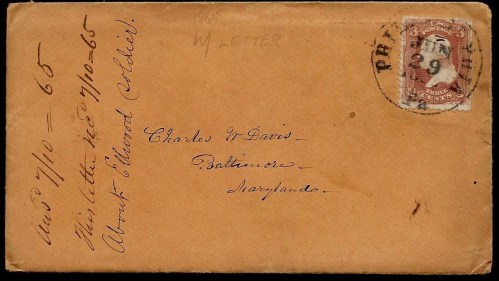
TRANSCRIPTION
Addressed to Charles W. Davis, Baltimore, Maryland
Frankford [Pennsylvania]
5th Mo. [May] 28th, 1865
My Dear Cousin,
A desire to hold a few minutes silent converse with thee informing of our welfare and to keep the feeling of friendship that has been from time to time cemented by a frequent correspondence during many, many years, and I do feel a desire that the interest in each other’s welfare may be continued while life endures. I again find myself alone writing, pen and paper and friends always at command. Elle has been staying with Jane the last three weeks. She says she has no tie to keep Jane at home now. Anna has been staying at Wade’s the last ten days. we expect them both home on next seventh day. William went over there yesterday and this P. M. Eth and Sarah went over to Germantown to attend the funeral of Dr. Moore, the three last will be home this eve.
I am one that very rarely feels lonely. I always can find something to occupy the mind or the hands. Thee knows there is a possibility of being alone in the midst of a crowd. Jane and Jeannie were here a couple of days last week. They are all well, but Jane looks very thin. Elle asked Jeannie who she would see here, wishing to know if she remembered Mother. She named us all. Elle says who else did Jeannie see there. She says, dear Grandmother is not there. Elle says where is she. She answered, “she is in heaven.” They showed her her father’s picture. She looked at it very earnestly for a long time, then says, “Dear little Poppo, won’t he come over here some day. I thought thee and cousin Lizzie would be willing to hear some of the remarks of the little ones so dear to us.
Last sixth day week we were all sitting on the piazza after tea, when to our surprise Charlie Marot says, “There’s Ell.” We all looked up and true enough, soldier Ellwood was coming down the street, sword in hand, and shoulder straps denoting his office. We were truly glad to welcome him safely home and soon had supper ready for him. His first words were, “I am a free man, can come and go when I please. I am done soldiering.” Thee may judge he interested us until a late hour. He will never be at a loss for long stories to entertain his friends. I told him I always felt that he would safely return.
He said immediately after the surrender of Petersburg, he asked permission to go see his Mother. His Colonel said go, and lent him a horse. He saw the whole family at the gate, in a state of great excitement wondering what would come next. He rode up, jumped off his horse, when his Mother recognized him, raising both hands she exclaimed, “Our son.” Never having heard he was in the army, judge their surprise. He soon calmed their fears, telling them all they had to do was to be loyal to the Government. Some of the neighbors came in, among them a young girl he had known before the war, told him they would die in the streets first.
His first visit was short. On his return there he said the feeling had changed very much. Seemed very anxious to do anything that would better their condition. Their money would not procure them a pound of beef or anything necessary to their comfort. They had imbibed the opinion that they were greatly oppressed by the North, from Ell’s account. He enlightened them greatly. His second visit was prolonged three days, enjoying the reunion of Father, Mother, Brother & Sisters who he found very destitute for many things. But they had a very fine garden and an abundance of fruit and vegetables—and a display of very rare flowers, the reward of his Mother’s care.
She told him that 38 shell had bursted over their garden and a minié ball passed through their bedroom, and one exploded over their kitchen which was detached from the house. Provisions & apparel were so high as to be almost out of reach. He said he went to market with his Father, he being a Union soldier was permitted to select a piece of fine large bullock for 25 cents a pound. His Father being a good judge of choice pieces, which with his Mother’s vegetables and fruit made them a choice dinner, enjoyed I trust with grateful hearts. He said one of the neighboring planters he knew very well seemed much reserved at first. While in conversation he asked are we to do if we have a crop out or other work needing attention if the niggers won’t work now. Are we to make them? Ell says turn them adrift and get others. The man says well I never thought of that. I thought the only way was to tie them up and whip them when they would not work.
Ell said when he returned to camp he found the army had moved & was 30 miles in advance of him. It was a “perilous” road for him to travel alone. When he overtook them, his Colonel said to him, “How’s your Mother?” He then proposed to send his company off on some mission. Ell says, “I would rather stay with the army.” He says, “Oh! very well.” Ell says these were the last words he heard him utter. In a very short time, he was shot dead. I do not remember his name. Ell seems to have been a favorite. He said this was his first visit after he was mustered out.
One other incident I must mention. He said his ride through Baltimore in the cars was one that he enjoyed to the full. Everything combined to make it pleasant—a lovely morning, fine music, flags flying, windows crowded with ladies handkerchiefs waving, and best of all, they were on their way home.
A letter from our cousin Ben Marot expresses great disappointment by being prevented from visiting his Philadelphia cousins. His time not having expired and officers being in demand, he now expects to be absent two years longer, having been allowed 30 days furlough to visit his home.
I have written a long letter all about strangers to thee. I trust no apology is needed as thee, I know, feels some interest in Ellwood’s welfare. I must tell thee William sent thee the extracts of the Yearly Meeting. I would like thee to see the account of the com’s visit to the President. I know thee would be pleased. They were certainly in their place. A tree is known by its fruits.
I wrote to Cousin Lizzie a short time ago. Give much love to her and everyone of my cousins and friends. Your friends in this vicinity are all well. Mary Beatty writes she and Julia Burns are preparing to go to Cape Island. I suppose we will see more of her now as vacation has commenced. Now farewell.
Very sincerely thy cousin, — Mollie
It was General [Thomas Alfred] Smyth who gave Ellwood permission to go see his mother. It was my blunder to call him Colonel.


 Spared & Shared 21